Medair scales up emergency health response as WHO warns DR Congo Ebola outbreak could become the world’s deadliest ever
.webp)
BUNIA, Democratic Republic of the Congo, 16. September — The Ebola outbreak spreading across the Democratic Republic of the Congo (DR Congo) could become the deadliest ever recorded if it continues at its current pace, according to the World Health Organization (WHO), as humanitarian organisation Medair scales up its emergency health response.
WHO Director-General Dr Tedros Adhanom Ghebreyesus has warned that, at its current pace, the outbreak could “eclipse” the 2014–2016 West Africa Ebola epidemic, the deadliest in history.
The latest data show the scale of the emergency: 7,200 confirmed cases and 3,475 deaths as of 12 September. The outbreak has now spread to six provinces. Almost one in every two people confirmed with the disease has died. Between 6-12 September another 514 cases and 249 deaths were reported. Over the preceding weeks, more than 50 deaths were reported each day on average – equivalent to approximately one confirmed Ebola death every 30 minutes.
The outbreak is already the largest ever recorded in DR Congo and the second-largest Ebola outbreak globally. Its speed is particularly concerning. During its first three months, the number of new cases rose much quicker than during the same early stages of both the 2014–2016 West Africa epidemic and DR Congo's previous major Ebola outbreak in 2018–2020, making it the fastest moving Ebola outbreak ever. By mid-August, more than 90 new cases a day are being reported on average – and there is not yet a clear sign that case rates have peaked.
“This is an exceptionally serious health emergency with a mortality rate that creates an atmosphere of panic in affected areas. It’s imperative to response quickly to protect community members from Ebola and from other illnesses and health conditions that tend to increase during such an outbreak. Medair has worked alongside communities in eastern DR Congo for 30 years, and our experience in emergency health provision and previous Ebola responses has enabled us to act quickly and serve the affected population. But as the outbreak continues to spread, working closely with the communities to ensure timely care-seeking and adoption of prevention measures will be critical to saving lives.”
— Thomas Simon, Head of Country Programme DR Congo, Medair
Medair scales up lifesaving healthcare
Medair is responding across areas affected by the outbreak. In North Kivu, Medair is operating a 20-bed Ebola Treatment Centre in Katwa, with additional capacity under construction. In Ituri, Medair is operating a 24-bed isolation unit in Sota for suspected Ebola patients. Medair was already supporting 46 health facilities before the outbreak began, and immediately strengthened infection prevention while helping continuing essential healthcare provision, as well as expanding to an additional nine health areas to respond to emerging Ebola outbreak hotspots.
Medair teams are supporting triage, isolation and referral; training health facility staff and community health workers; strengthening infection prevention and control at health facility and community level; improving water and sanitation infrastructure; and enabling health facilities to continue providing essential services.
Fighting Ebola also means fighting misinformation
Fear, rumours and misinformation remain significant obstacles to controlling the outbreak. WHO reports that approximately 60% of confirmed deaths during the past six weeks occurred outside designated Ebola treatment facilities, highlighting challenges around early detection, referral and access to care.
For this reason, Medair's response extends beyond treatment centres. Teams work with community health workers and trusted local leaders to explain Ebola symptoms and prevention measures, address fears and misinformation, and encourage people to seek treatment early.
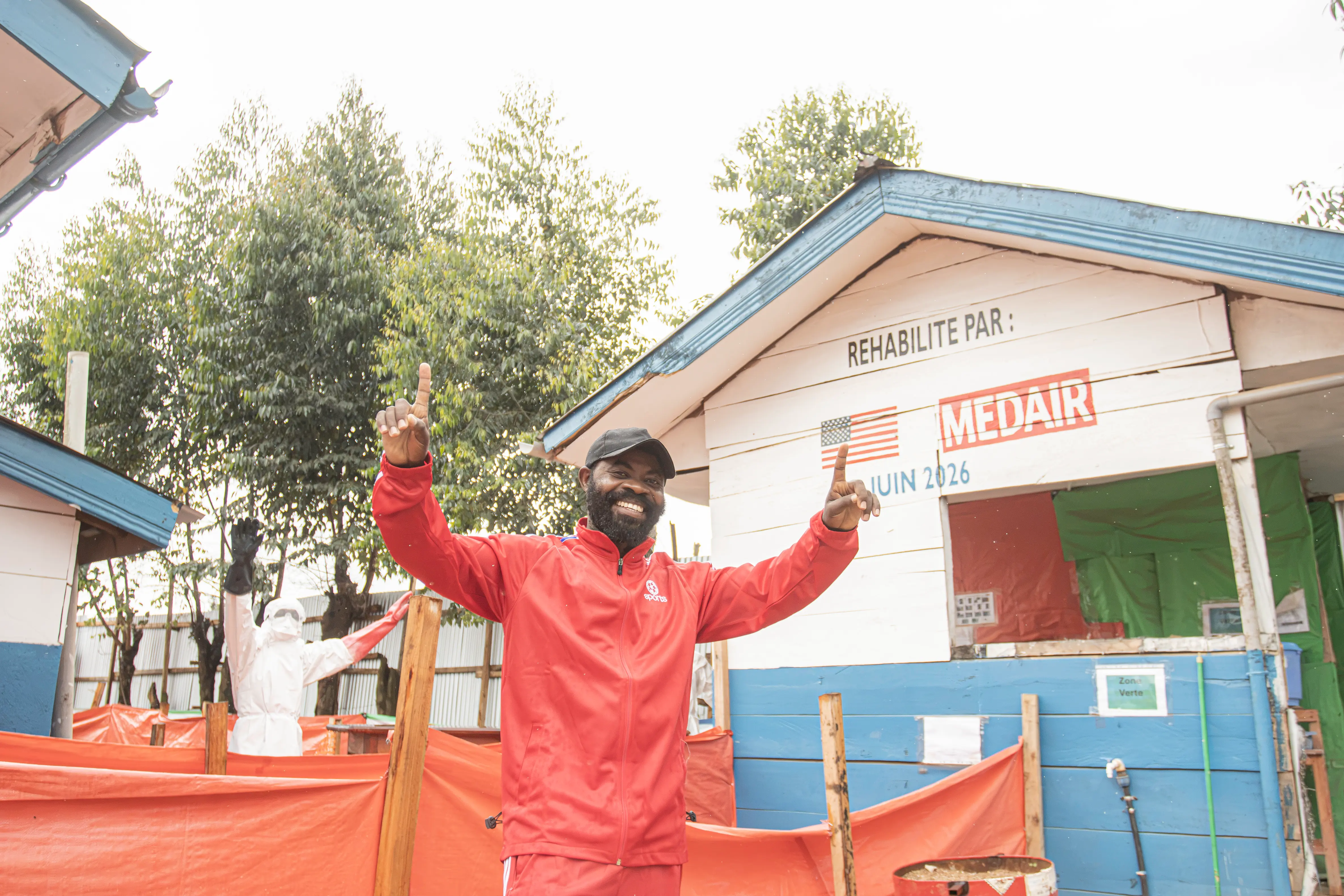
For Alain, an Ebola survivor treated at the Medair-supported Ebola Treatment Centre in Katwa, those fears were deeply personal. After his younger brother died from Ebola, Alain developed symptoms himself. Rumours circulating in his community made him afraid of going to the treatment centre.
There, his experience changed.
“The nurses took the time to talk to me, reassure me, and answer my questions. Little by little, they became my friends. Their support gave me back the strength to eat, to follow the treatments, and to believe in my recovery again.”
Alain eventually recovered. He encouraged five other members of his family who had been exposed to Ebola to seek treatment. All five survived.
“Rumours can kill as surely as a disease. Some people die because they arrive at treatment centres too late due to fear.”
Media enquiries
Medair can facilitate interviews with health and humanitarian specialists involved in the response and provide approved photographs and video footage.
Please contact:
Maria Elena Irausquin
Tel. +41 (0)78 353 20 35
Email : mariaeirausquin@gmail.com
About Medair
Medair is an international humanitarian organisation founded in 1989, specialising in emergency response and recovery. Based on Christian values, we respond to the most urgent crises, bringing life-saving aid to vulnerable communities affected by conflict, natural disasters or disease.
Medair specialises in health, nutrition and WASH (water, sanitation & hygiene) activities, and prioritises the hardest to reach communities. Currently working in over 10 countries worldwide, Medair works in partnership with local communities to save lives and restore dignity, while building capacity and resilience for future crises.
We go the extra mile to reach people impacted by emergencies and crises – regardless of race, creed or nationality – so they can live in dignity, free from human suffering and with hope for a better future.
We are guided by the humanitarian principles of impartiality, independence and neutrality.
Sources:
[2] https://insp.cd/sitrep-n098-mvebdb-20-08-2026/
[4] https://www.who.int/emergencies/disease-outbreak-news/item/2026-DON614?utm
[5] https://www.bbc.com/news/articles/cgk4pex4mn8o
.webp)
%20(1).webp)
.webp)